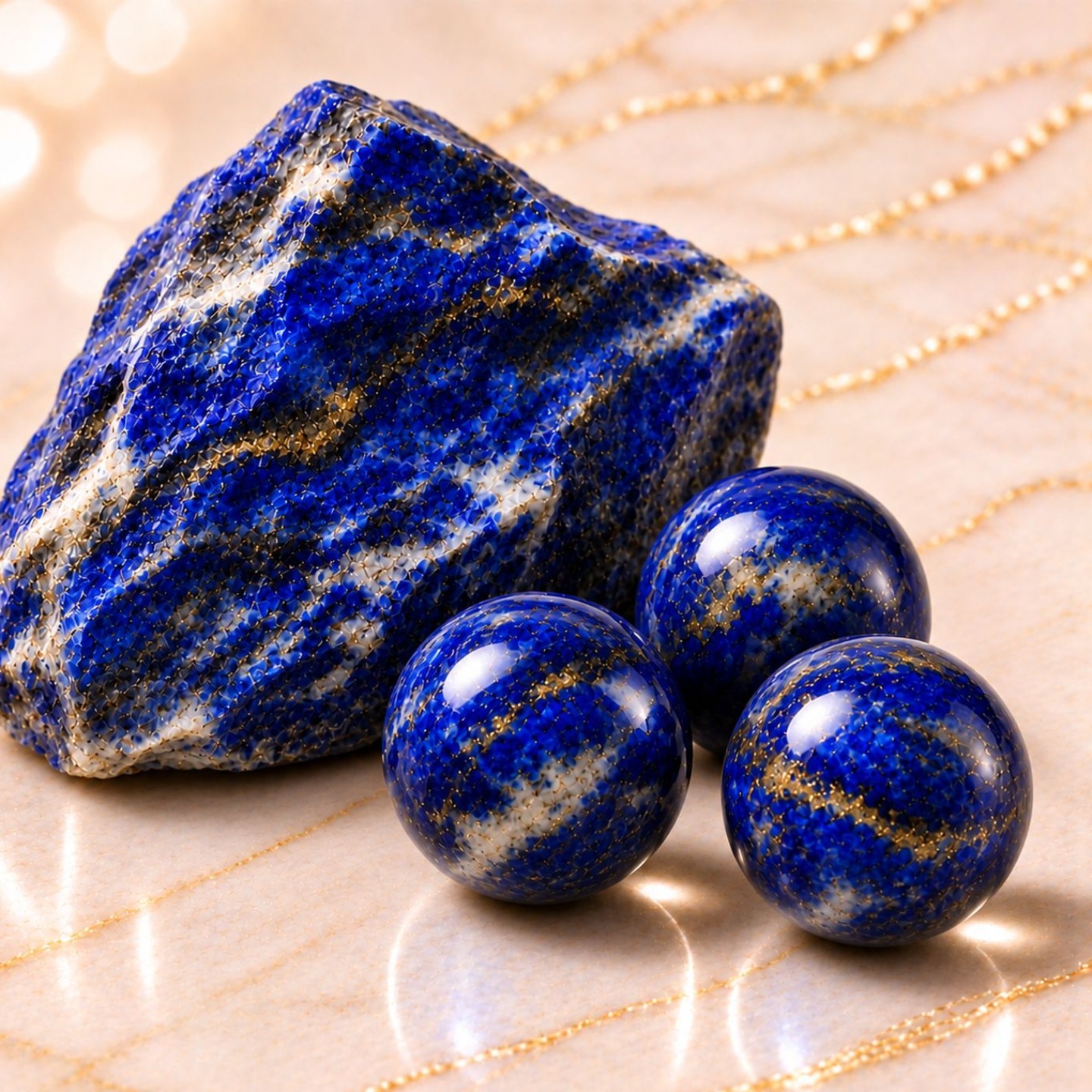
Lapis lazuli is one of the most ancient gemstones. Its deep blue-violet colour, often with golden flecks of pyrite and white veins of calcite, recalls a starry night sky.
Origin of the name
The name comes from the Latin lapis – "stone", and the Persian lazhward – "blue". The words "azure" and "lazure" share the same root.
The stone of the pharaohs
Lapis lazuli has been mined for over 6,000 years in the mountains of Afghanistan – the mines of Badakhshan are among the oldest working mines in the world. The ancient Egyptians valued it as highly as gold: the famous golden mask of Tutankhamun and countless amulets and scarabs are inlaid with it. Egyptian ladies also used the ground stone as eyeshadow.
The painters' stone
For centuries the most expensive blue paint – ultramarine – was made from ground lapis. It cost more than gold, and painters saved it for the most important parts of their pictures – for example, the robe of the Virgin Mary. It was also used to paint the turban of Vermeer's "Girl with a Pearl Earring".
Symbolism
Traditionally lapis lazuli is a stone of friendship, sincerity and wisdom. It is believed to bring harmony, understanding and inner truth. It was the stone of kings and of priests.
In jewellery
Lapis lazuli jewellery is striking and noble. It looks beautiful in gold and silver and combined with pearls and white crystals. With a hardness of 5–5.5 on the Mohs scale, lapis is a softer stone – protect it from knocks and from water with detergents.